A Millennium of Legendary Favorite Foods of the Malay Kingdoms

A Minang Mansion.
Celebrating four seasons at the tropics

The Petronas Towers, Malaysia
Growing up we were reminded time and again that our ancestors left their motherland on a quest in search of alternative lifestyles. This mass migration that lasted several decades has taken place a little under 200 years ago. Due to logistical constraints and other limitations in long distance travel, traditional practices easily became part of their transportable belongings.
When arrived, these immigrants experienced a shortage of environmental, climatic and social elements that initially defined the true purposes of these live outs. Yet the spiritual necessity to connect with the core remains. Consequently, stronger emphases were placed upon readily available symbolic representations. In specific cases, adapted versions of practices may be observed. Today, a vast number of working Malaysian citizens of Chinese descent are great grandchildren of the Han people.
The reflections of this nostalgia can be observed throughout Malaysia particularly during ethnic festivals and important celebrations. Much of these traditions were passed down to the young through verbal means and reenactments. Costumes, seasonal cuisines and special performances were worn, eaten and carried out as some of the activities.
When arrived, these immigrants experienced a shortage of environmental, climatic and social elements that initially defined the true purposes of these live outs. Yet the spiritual necessity to connect with the core remains. Consequently, stronger emphases were placed upon readily available symbolic representations. In specific cases, adapted versions of practices may be observed. Today, a vast number of working Malaysian citizens of Chinese descent are great grandchildren of the Han people.
The reflections of this nostalgia can be observed throughout Malaysia particularly during ethnic festivals and important celebrations. Much of these traditions were passed down to the young through verbal means and reenactments. Costumes, seasonal cuisines and special performances were worn, eaten and carried out as some of the activities.
The Straits Settlements Era
a brief introduction
|
The year was 1824, with signing of The Anglo-Dutch Treaty, the Malayan Peninsula was passed to British while the immensity of Indonesian Archipelago to the Dutch. The British intention towards Malaysia was resolutely a policy of “trade, not territory”.
Two years succeeding the treaty, the British crown held a group of coastal localities consisting of the Island of Penang, Malacca, Singapore, Province Wellesley and surrounding smaller islands under the collective name of Straits Settlements. Instead of arriving in mass numbers, the British established themselves as the ruling leaders. Migrants were employed from China, India and trading partners from other parts of the British Empire to administer the new trading platforms. These migrants served as general laborers, administrative officials and tradesmen. The close association of the region and the establishments of these coastal free trade portals with no attachment of territorial objectives, the British successfully dominated the trade routes between Europe and Asia. As a result, the Straits Settlements developed as an intriguing melting pot of cultures. Immigrants from Asia lived side by side with the Europeans, as well as the indigenous Malays. |
 Putrajaya. Today's Federal Administrative Center of Malaysia |
The Harmony Prevails....
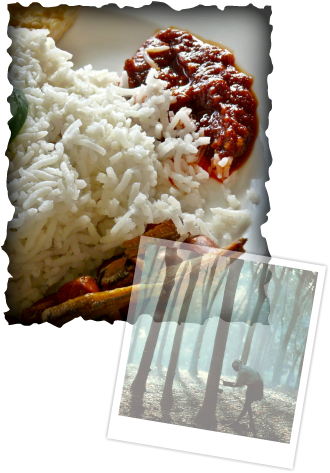
A rubber plantation at dawn
Nasi Lemak
~steamed coconut jasmine rice,
~roasted peanuts,
~chilled cucumber,
~hardboiled eggs,
~fried ikan bilis and
~sweet onion chili sambal.
Meaning “Rich Rice”.
A versatile all-in-one rice dish, it is
commonly taken as breakfast or
afternoon snack before
a more substantial meal.
This combination consists of components
from major food groups and
components are prepared separately.
Traditionally it is wrapped in banana leaves
for easy transport.
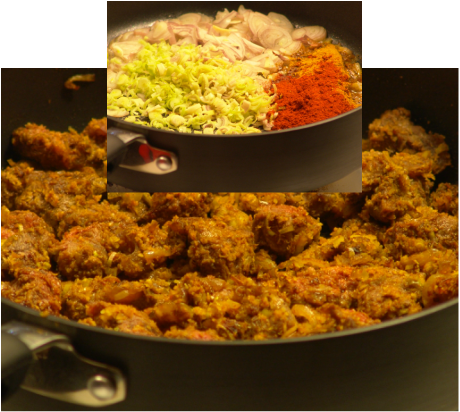
Rendang fom start to finish
Beef Rendang
~herbs - shallots, garlic, lemon grass, dried kaffir leaves
~spices - cardamom, coriander, tumeric, chili, candle nut, galangal
~beef briskets
~coconut milk
~sea salt
Often compared to the basic approach
of making boeuf bourguignon. This slow cooked
peasant meat dish is meant to tenderize stubborn
cut of beef.
The process also promotes a more gradual
and thorough take ins of various local herbs
and spices.Traditionally eaten with
lemang (rice cooked in bamboo trucks)
or tumeric glutinous rice.
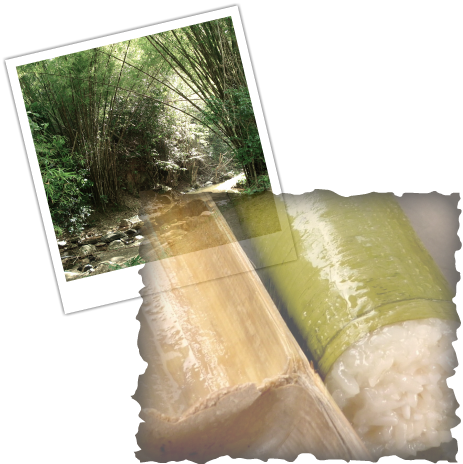
Bomboo bush by a stream and Lemang, ready to be serve.
Lemang
~bamboo trucks, as cooking vessels
~greased banana leaves
~sweet rice
~salt
~potable water
In the old days, rice paddy fields were
ploughed and irrigated near natural
water sources. Rivers and streams
are readily available throughout Malaysia.
Bamboo bushes are part of the package
blessed by mother nature. The monocot
can rapidly outgrown nearby
food crops if not controlled frequently.
As a result of trimmings, this recyclable
material is cleverly put into
culinary application.
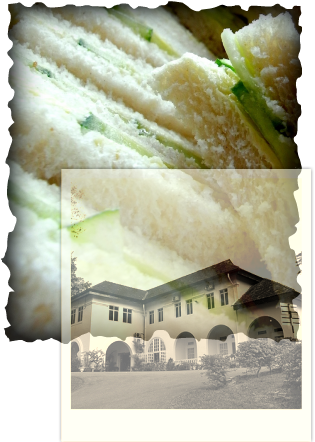
A Colonial Rest House in the State of Pahang
Colonial tea sandwich made with chicken
~white bread
~cooked chicken breast
~chilled cucumber
~fresh butter
~white pepper dusts
As a favorite snack, it served as a balanced
composition that contains nutrients
from important food groups. It swiftly
replenishes tired and dehydrated travelers.
It can also be transported easily.
Weather patterns are often moody in the tropics.
Searing heat reaching thirty three degree Fahrenheit
could experience a very very wet showers
without reasonable warnings.
Rest Houses were build during the settlements era
to provide both shelters and office spaces for
administering trade works between significant
destinations. They were designed to equip with most
modern infrastructures of its time. This included
on demand running water, electricity,
communication systems and banks. Modern kitchens
in rest houses also enabled Western inspired bakery
items such as wheat flour based cakes, biscuits,
cookies, tarts and pies to be reproduced;
hence putting them as pioneers of the many
Western bakeries throughout the country today.
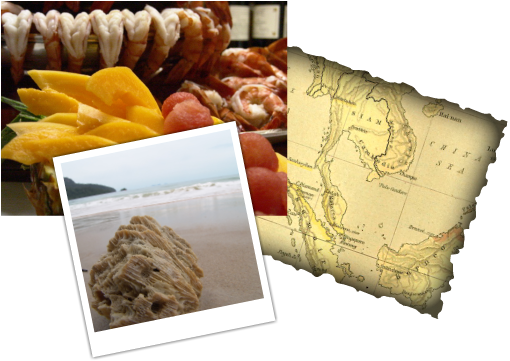
Fishing cove off Pangkor Island, Perak Malaysia
Prawns served chilled with chili preserve
Malaysia Peninsula has a total land area of
51,000 sq. mile with 1,300 miles of coastline.
This relatively small area to coastline ratio along
with reasonably calm and shallow waters encourage
fishery. Moderate water temperature provides
natural breeding heavens for a wide variety of
edible marine creatures. Prawns are an all time favorite.
Stop by the beach for a taste of this succulent
catch. Most simply submerge in lightly salted boiling
water for a short time and chilled with ice shavings.
When ready to eat, remove and discard shells. Dip in
warm lime-chili preserve lightly sweeten with
granulated sugar.
Malaysia Peninsula has a total land area of
51,000 sq. mile with 1,300 miles of coastline.
This relatively small area to coastline ratio along
with reasonably calm and shallow waters encourage
fishery. Moderate water temperature provides
natural breeding heavens for a wide variety of
edible marine creatures. Prawns are an all time favorite.
Stop by the beach for a taste of this succulent
catch. Most simply submerge in lightly salted boiling
water for a short time and chilled with ice shavings.
When ready to eat, remove and discard shells. Dip in
warm lime-chili preserve lightly sweeten with
granulated sugar.
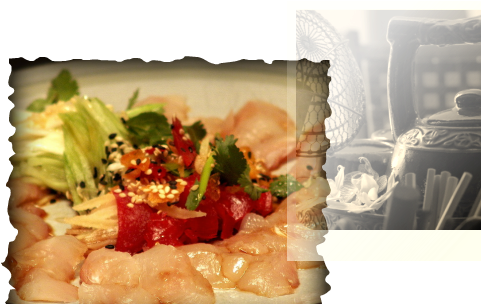
Seconds before Yee Sang is tossed
Lou Yee Sang
~fresh oily fish of sashimi grade
~sesame seeds
~candied citrus fruit peels
~candied ginger
~cucumber julienne
~turnip julinne
~cilantro
~scallion
~fried rice vermicelli
~crispy wonton strips
Figuratively indicates "to extract from a prospering source".
During a festive celebration, friends gather to
share the making and enjoyment of this communal dish.
The dish's symbolic implication:
"Let's put our energies together to build wealth."
~fresh oily fish of sashimi grade
~sesame seeds
~candied citrus fruit peels
~candied ginger
~cucumber julienne
~turnip julinne
~cilantro
~scallion
~fried rice vermicelli
~crispy wonton strips
Figuratively indicates "to extract from a prospering source".
During a festive celebration, friends gather to
share the making and enjoyment of this communal dish.
The dish's symbolic implication:
"Let's put our energies together to build wealth."
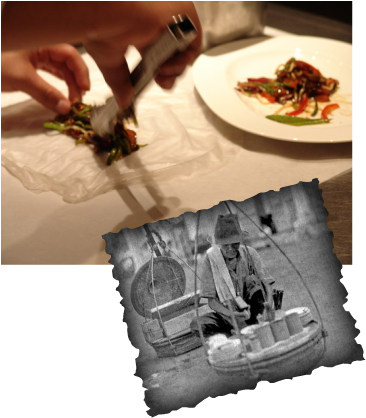
A colonial era food stand
Popiah
~wheat flour skin
~shredded jicama
~shrimp
~cooked chicken
~sweet bean sauce
~chili paste
Meaning thin-wrapped savory strudels in Hokkien dialect.
This delicious snack can be eaten at anytime throughout the day.
Traditionally, they were made primarily in Hokkien families
for home consumption. They were also available from mobile
food hawkers. The item quickly gain popularity for its complex
flavor profile and simple construction. Today, popiah is still
being made in households and remains a tourists must try.
~wheat flour skin
~shredded jicama
~shrimp
~cooked chicken
~sweet bean sauce
~chili paste
Meaning thin-wrapped savory strudels in Hokkien dialect.
This delicious snack can be eaten at anytime throughout the day.
Traditionally, they were made primarily in Hokkien families
for home consumption. They were also available from mobile
food hawkers. The item quickly gain popularity for its complex
flavor profile and simple construction. Today, popiah is still
being made in households and remains a tourists must try.
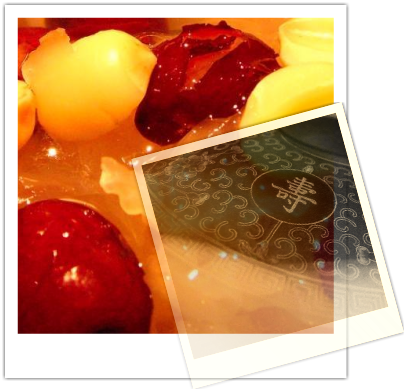
~ Longevity.
Candied Red Dates Soup
~dried pitted red dates
~natural rock candy
~dried snow ear mushrooms
~dried lotus seeds, hypocotyls and radicals removed
Goodnesses united in a bowl. Take this
fiber-packed candied soup with mystical
medicinal properties and you shall be immortal...
well....for a long long time.
Tremella Fuciformis - Snow ear
Some believe that the biological instinct
observed in matrix formation of snow ear mushroom
during growth may have anti aging qualities.
Nelumbo Nucifera - Lotus seeds
Others argue that lotus seeds may assist
in dispersing toxic from bodies and sustain
a healthy stamina.
©2013-2014 Yihshyong Leong
~dried pitted red dates
~natural rock candy
~dried snow ear mushrooms
~dried lotus seeds, hypocotyls and radicals removed
Goodnesses united in a bowl. Take this
fiber-packed candied soup with mystical
medicinal properties and you shall be immortal...
well....for a long long time.
Tremella Fuciformis - Snow ear
Some believe that the biological instinct
observed in matrix formation of snow ear mushroom
during growth may have anti aging qualities.
Nelumbo Nucifera - Lotus seeds
Others argue that lotus seeds may assist
in dispersing toxic from bodies and sustain
a healthy stamina.
©2013-2014 Yihshyong Leong
